Table of Contents
A few years ago, most network engineering work stayed on-site almost by default. Someone had to be in the building to touch the switch, walk the server room, or physically re-patch a rack. That constraint has mostly disappeared. Between cloud migration, SD-WAN rollouts, and infrastructure that’s managed through a dashboard rather than a keyboard plugged into a router, the case for keeping a network engineer local has gotten a lot weaker.
That shift shows up in how companies staff these roles. Distributed teams are now normal rather than an exception, and a lot of infrastructure work is naturally project-shaped: a firewall migration, a WAN redesign, a security audit ahead of a compliance deadline. Work like that doesn’t always need a full-time hire sitting in a building. It needs the right skill set, available when the project needs it, for as long as the project needs it.
Why Remote Hiring for Network and Infra Roles Is Growing
Three things are driving this at once.
- First, cloud migration means a growing share of “network” work is really about virtual networking, cloud security groups, and hybrid connectivity none of which requires physical proximity to hardware.
- Second, distributed teams have made remote collaboration tooling good enough that a network engineer in another time zone isn’t the operational headache it used to be.
- Third, a lot of infra work genuinely is contractor-shaped: it has a defined scope, a start date, and an end date, even if the timeline sometimes moves.
None of that means hiring got easier. If anything, it got more complicated, because now a company evaluating network talent has more paths to choose from and no obvious default. The freelance-marketplace approach that works fine for a quick script or a one-off website fix runs into real limits once you’re talking about someone with access to production routing tables, firewall rules, or client VPN configs.
Hiring Models Compared
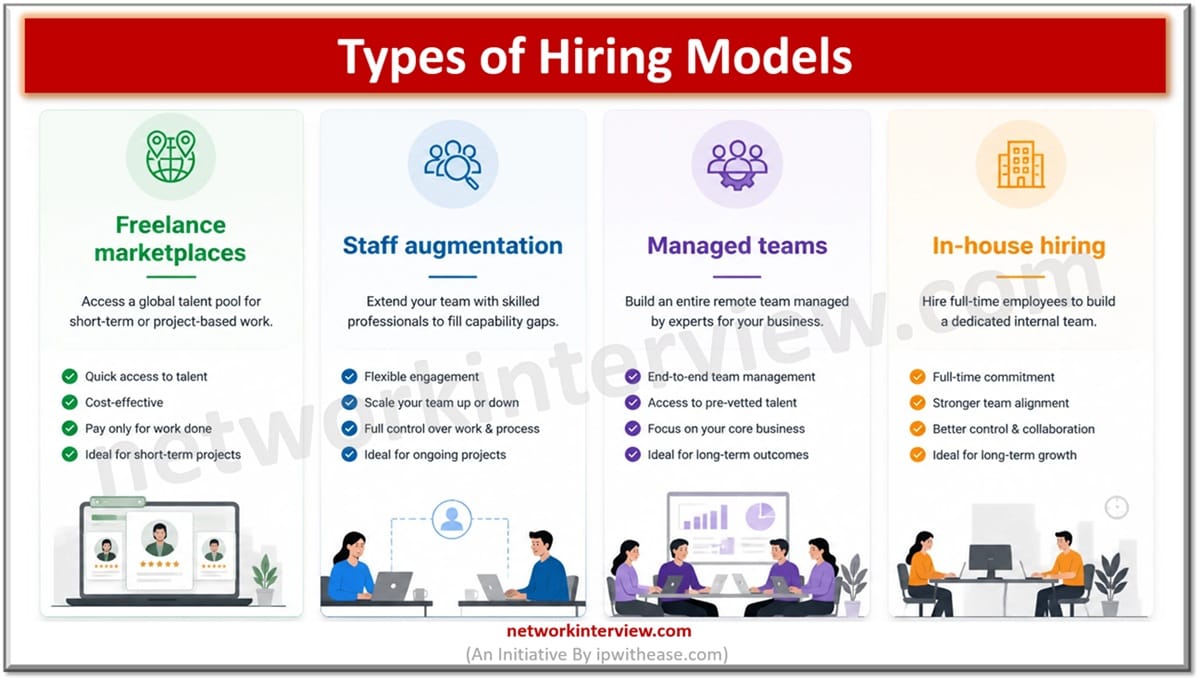
There isn’t one right answer here it depends on scope, duration, and how sensitive the environment is. Broadly, companies are choosing between four models:
- Freelance marketplaces — fast to start, low commitment, good for narrowly scoped or short-duration work like a one-time audit or a small config change.
- Staff augmentation — a vendor supplies individual engineers who plug into your existing team and processes, useful when you need specific skills without taking on a full hiring cycle.
- Managed teams — a vendor owns a defined slice of the infrastructure end to end, which works well for ongoing operations like network monitoring or managed firewall services.
- In-house hiring — full control and the deepest institutional knowledge, but the slowest to stand up and the hardest to scale down if a project ends.
Each of these trades off speed against control. Freelance and staff augmentation get you moving fast. Managed teams and in-house hiring give you more oversight and continuity, at the cost of a longer ramp-up. Most companies end up using more than one model at once a managed team for day-to-day operations, say, with staff augmentation brought in for a specific migration project.
Where Platforms Fall Short for Technical Hiring
Marketplace platforms are genuinely good at solving a narrow problem: finding someone quickly for a well-defined task. They’re weaker once the work involves deeper trust. Vetting on most marketplaces is largely self-reported ratings, reviews, a portfolio which tells you very little about whether someone can be handed root access to a core switch or trusted to design a segmentation strategy for a regulated environment.
Security clearance and background requirements are another gap. Government contracts, healthcare networks, and financial infrastructure often require specific clearances or at minimum a documented background check, something most freelance platforms simply aren’t built to verify. NDAs and IP protection raise similar questions. A platform-sourced freelancer might sign a standard NDA template, but enforcement and liability get murky fast if that person is based somewhere with limited legal recourse.
This is roughly the point where a lot of infrastructure teams start looking past the marketplace model entirely. For teams that outgrow freelance marketplaces, it’s worth looking at upwork alternatives for teams, since the vetting depth and contractual structure that infrastructure work needs usually sit outside what a general-purpose freelance platform was built to handle.
A Checklist for Evaluating a Hiring Platform or Vendor
Before committing to a vendor or platform for network and infrastructure hiring, it’s worth working through a short list of questions rather than comparing rates alone:
- Technical vetting — does the vendor run its own technical interviews and hands-on assessments, or just pass along a resume?
- Security practices — background checks, access controls, and how credentials and VPN access are provisioned and revoked.
- Contract flexibility — can you scale the engagement up or down as the project changes, and what does an early exit actually cost?
- Cost structure — is pricing transparent, and does it account for onboarding, management overhead, and the cost of a bad match, not just the hourly rate?
None of these questions have a universal right answer. What matters is that you’re asking them before signing, not after a config error takes down a client’s WAN.
Matching the Model to the Project
A short-term network audit and a multi-year infrastructure buildout are different problems, and they usually call for different hiring models. An audit is bound, you know roughly what it costs to get wrong, and the exposure window is short, so a freelance marketplace or a single contractor through staff augmentation is often enough. Another form of long-term risk is something with sustained access to the production environment and deep organizational memory, and where the damage if the wrong person is placed in the role, accumulates over months or years instead of weeks.
The companies that get this right tend to treat hiring model selection as its own decision, separate from budget. It’s less about finding the cheapest way to fill a role and more about matching the level of trust the work requires to the level of vetting the hiring model actually provides.