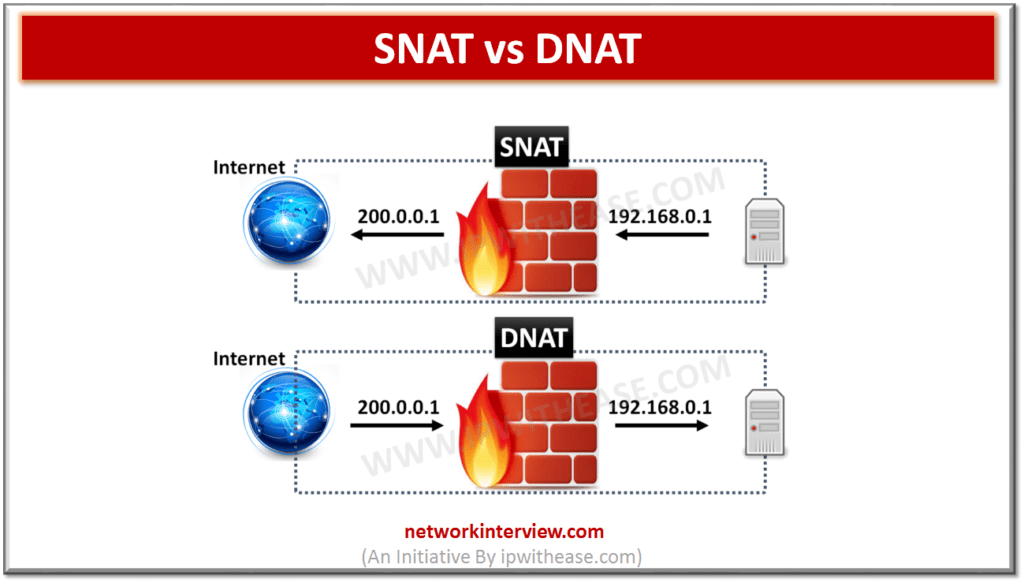
In the networking world IP address translation is required so that internal systems could have access to the external world or Internet. The IPv4 scheme can have a maximum of four billion IPv4 addresses in theory but the actual number is less when it comes to practical usage. As some range is reserved for broadcast etc. the 32 bits IPv4 scheme allows for roughly 4.2 billion possible IP address combinations which is getting exhausted quickly due to rapid expansion and adoption of Internet space globally.
NAT technology is helping in the conservation of IP addresses and also offers more security and privacy by hiding device actual IP addresses to the external world. Similarly PAT also acts as an extension of NAT and helps to conserve IP addresses.
Today we look more in detail about Network address translation (NAT) and Port address translation (PAT) terminologies, understand their working and differences, use cases.
What is NAT?
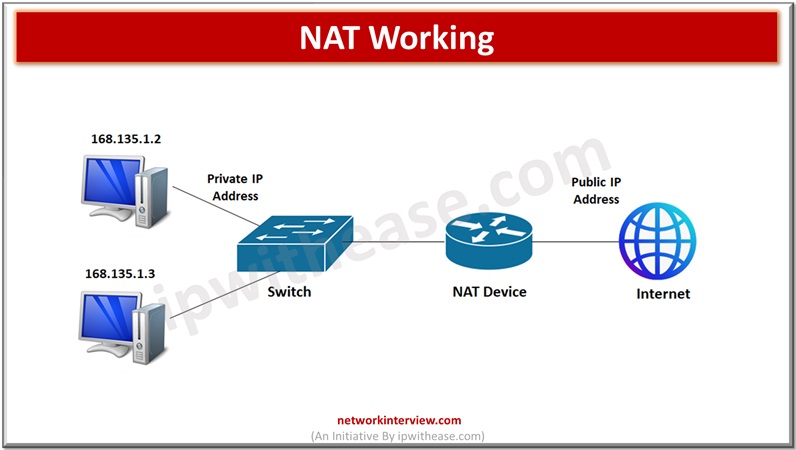
Network Address translation (NAT) connects two networks and maps private and public IP addresses. Private here refers to the host address in an internal network (LAN) and public means address assigned by NIC or service provider and it represents private address to the public world. The purpose of NAT is to slow down the rate of depletion of IP address space by enabling many private IP addresses to represent number of public IP addresses.
Related: NAT CheatSheet
NAT Advantages & Disadvantages
Advantages
- Registered Public IP addresses are preserved and their depletion is contained
- Address overlap occurrence is significantly reduced
- Flexibility in connection establishment
- No need to remember address removal at the time of changing network
Disadvantages
- Could lead to switch path delays due to translations
- End to end traceability is lacking
- Some applications are not compatible to use NAT
Use case for NAT
NAT is useful when a network uses a private IP address and you want to connect it to the Internet without using many public IP addresses. NAT helps to improve security by hiding internal network structure and prevents direct access from the Internet. NAT can be dynamic or static.
What is PAT?
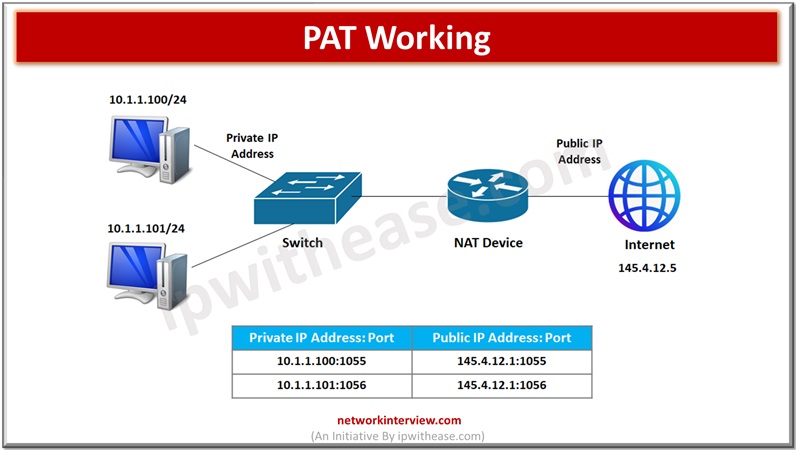
Port address translation (PAT) is a type of dynamic NAT which can be configured at port level to optimize remaining IP address range also. PAT maps multiple source local addresses and ports to a single public IP address and port from a port pool of IP addresses which are routable to destination. Interface IP address is used in combination with a unique port number here. PAT is of two types:
- Static: that permits a device within a private network to be assigned a fixed or static port number for a particular service or application.
- Overloaded: that enables multiple devices within a private network to share a single public IP address and a single port number for various connections or sessions.
PAT Advantages & Disadvantages
Advantages
- Conservation of IP addresses by assignment of single public IP address to group of hosts using unique port numbers
- Reduction in vulnerabilities or security attacks as private IP address prevents exposure of public IP address to outside world
Disadvantages
- More than one same type of public services cant be executed having single IP address NAT
- Limitation on number of entries in internal table to keep track of connections
Use case for PAT
PAT is useful when the number of devices is more than the public IP addresses, and you want to enable simultaneous access to the Internet. PAT helps to improve security by making it hard for attackers to identify and target systems based on their port numbers. PAT can be used in combination with static or dynamic NAT.
Comparison: NAT vs PAT
Below table summarizes the differences between the two IP address translation techniques:
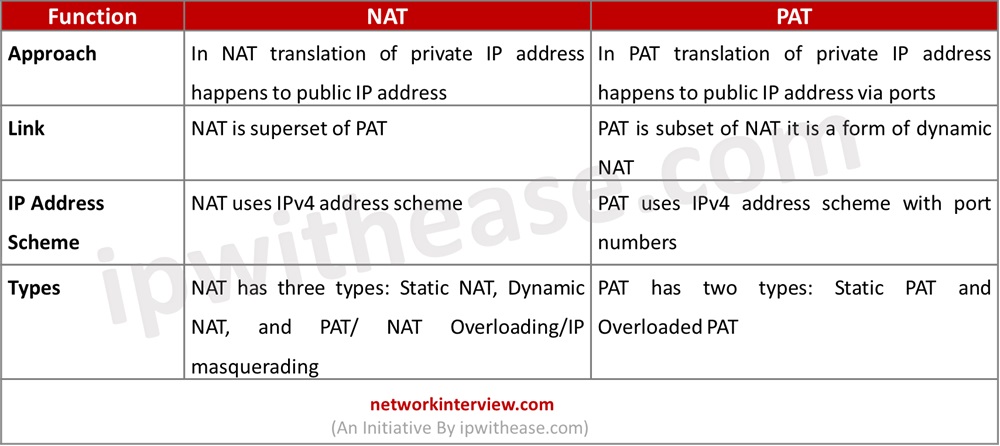
Download the comparison table: NAT vs PAT
Continue Reading:
NAT Type 1 vs 2 vs 3 : Detailed Comparison