Computer communication networks are growing at a rapid pace, they are based on technology which provides the technical infrastructure, whereas routing protocols are used for transmission of data packets across the Internet. Routing protocols specify how routers communicate with each other, how routing information will be stored? Prior knowledge of routes helps to choose the most optimal path for data transmissions. There are wide variety of routing protocols being used
Today we look more in detail about two link state routing protocols OSPF (Open shortest path first) and ISIS (Intermediate System to Intermediate System) dynamic routing protocol and similarities and key differences, OSPF vs ISIS, between both of them.
What is OSPF Dynamic Routing Protocol?
OSPF (Open shortest path first) is used in large enterprise networks. It collects link state information from routers in the network and determines the routing table information for packet forwarding. It creates a topology map of the network. OSPF exchanges routing information only when there is a change in network topology and it is best suited for complex networks which compromise multiple subnets by calculating shortest path effectively with minimum network traffic when change occurs.

Features of OSPF
- OSPF has complete visibility of network topology which let routers calculate best routes for all incoming requests
- There are no limitations on hop count, so it converges faster and has better load balancing
- It Multicasts link-state updates and sends the update only when there is a change in network
What is ISIS Dynamic Routing Protocol?
ANSI ISO developed an open standard and classless Interior gateway link state protocol named IS-IS (Intermediate System to Intermediate System). IS-IS uses Dijkstra SPF (shortest path first) algorithm to build IS-IS protocol databases to calculate the best path. It uses cost value for best path selection. It has fast convergence and large scalability.

Features of ISIS dynamic routing protocol
- Very fast convergence and large scalability
- Area structure is more flexible
- Extensible for both IPv4 and IPv6
- Scalability can be achieved with single area
Commonalities between: OSPF & ISIS Dynamic Routing Protocols
- Both are link state routing protocols
- OSPF and IS-IS dynamic routing protocol uses Dijkstra SPF (Shortest Path First) algorithm
- OSPF and IS-IS dynamic routing protocol supports Variable length subnet mask (VLSM)
- Both are highly scalable protocols
- Both has highest convergence time after changes
- Both are open standard protocols
- Both have hierarchical structure (two hierarchy levels)
- Both support LANs and point-to-point protocols in same way
- Both use periodic Hello messages for establishment of neighbour
Comparison Table: OSPF vs ISIS
Let’s understand the differences between the two types of protocols in tabular form:
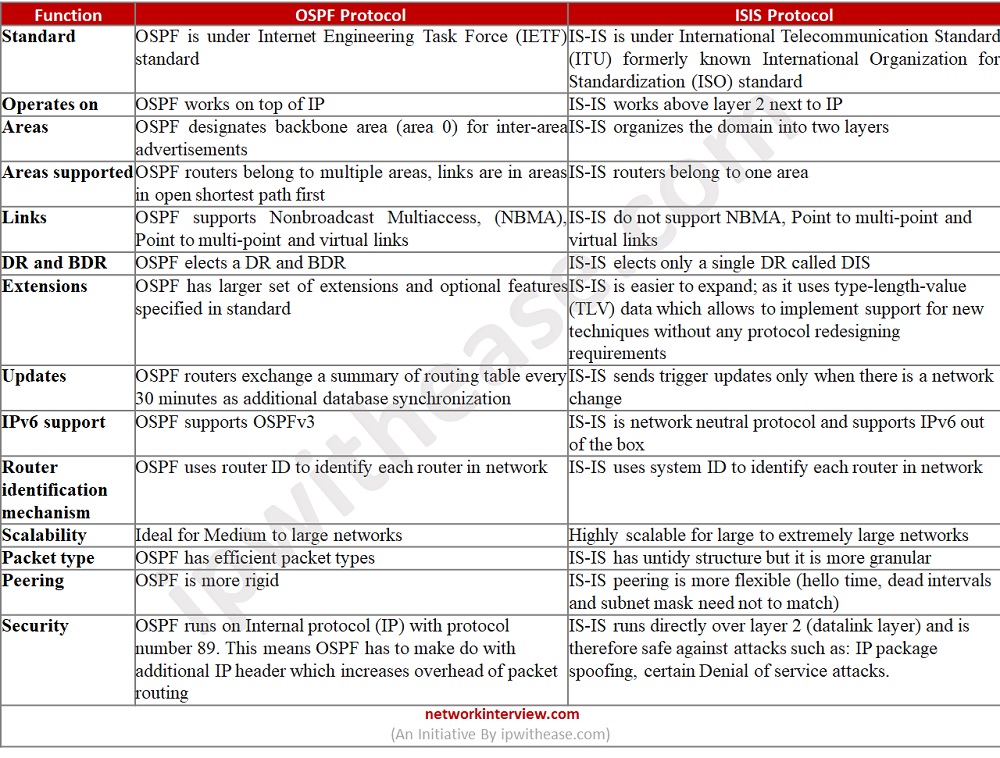
Download the comparison table: OSPF vs ISIS