Table of Contents
The IT hiring conversation has moved past “learn to code.” By 2027, the roles getting the most attention sit at the intersection of AI, cloud, security, and governance — jobs that didn’t have formal titles even three or four years ago. If you’re planning your next career move, or trying to figure out where to invest your certification budget, this list of Emerging IT Job Roles is a good place to start.
Top Emerging IT Job Roles
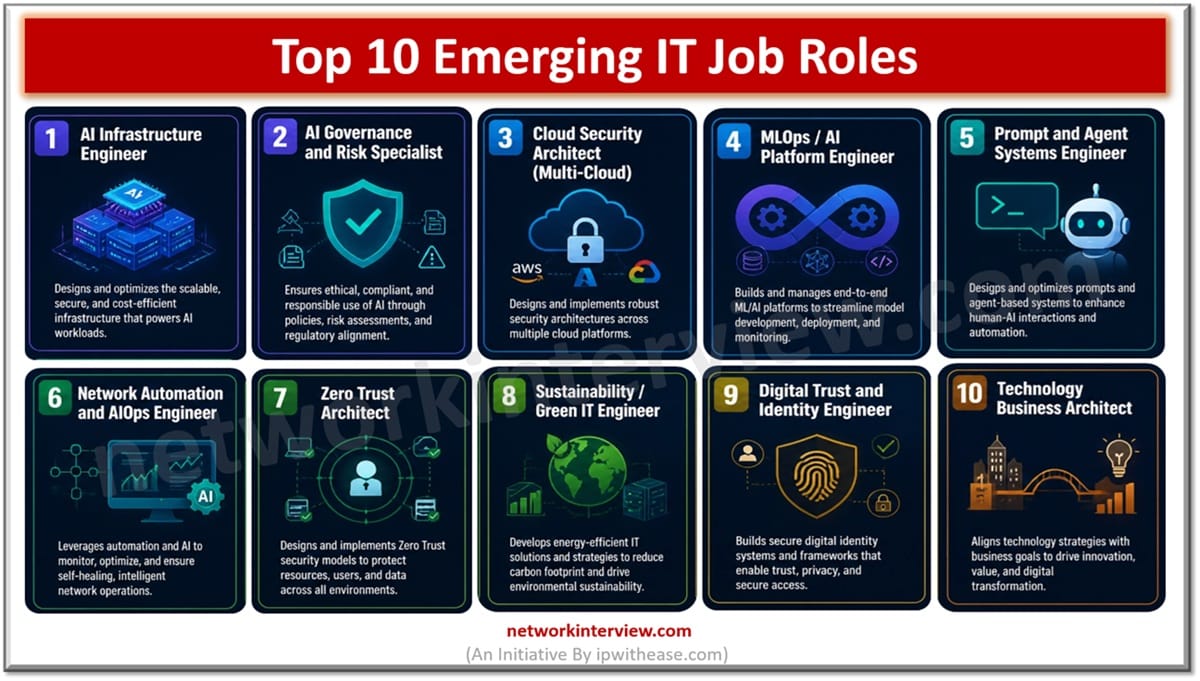
1. AI Infrastructure Engineer
Every enterprise racing to deploy large language models needs someone who can actually run the plumbing underneath them — GPU clusters, high-throughput networking, storage that can keep up with training and inference workloads. This role blends classic data center and networking skills with a working knowledge of AI hardware stacks. It’s less about building models and more about making sure the infrastructure can feed them without falling over.
2. AI Governance and Risk Specialist
As organizations deploy AI into decision-making pipelines, someone has to own the question of whether that deployment is safe, compliant, and explainable. This role sits between legal, security, and engineering — auditing models for bias, tracking regulatory requirements across regions, and building the internal frameworks that keep AI adoption from turning into a liability. Expect this to become a standard fixture in mid-to-large enterprises well before 2027 is over.
3. Cloud Security Architect (Multi-Cloud)
Cloud security roles aren’t new, but the shape of the job has changed. Companies running workloads across AWS, Azure, and GCP simultaneously need architects who can design consistent security postures across all three — not specialists who only know one platform. Identity federation, cross-cloud network segmentation, and unified policy enforcement are becoming core skills rather than nice-to-haves.
4. MLOps / AI Platform Engineer
Data scientists build models; MLOps engineers make sure those models actually reach production, stay monitored, and get retrained without drama. Think of it as DevOps for machine learning — CI/CD pipelines, model versioning, drift detection, and rollback strategies. As more companies move from AI pilots to production systems, this role becomes the difference between a proof of concept and a working product.
5. Prompt and Agent Systems Engineer
This role has evolved quickly. It started as “prompt engineering” and has grown into designing and orchestrating autonomous AI agents that can chain tasks, call tools, and interact with enterprise systems. The people who do this well understand both the language model layer and the software architecture needed to make agents reliable, auditable, and safe to deploy at scale.
6. Network Automation and AIOps Engineer
Traditional network engineering is being reshaped by automation and AI-driven operations. Instead of manually troubleshooting outages, network teams are increasingly expected to build self-healing networks — using telemetry, machine learning, and automation frameworks to predict and resolve issues before they affect users. Engineers who can pair strong networking fundamentals with scripting and automation tooling are in a strong position here.
7. Zero Trust Architect
Zero trust has gone from buzzword to baseline expectation, especially as hybrid work and multi-cloud environments erase the old network perimeter. This role focuses on designing identity-first security architectures — continuous verification, micro-segmentation, and least-privilege access — across users, devices, and workloads. It’s a natural next step for security and network architects looking to specialize.
8. Sustainability / Green IT Engineer
As data center energy consumption comes under regulatory and public scrutiny, organizations are hiring engineers specifically focused on reducing the environmental footprint of their infrastructure — from power-efficient data center design to workload scheduling that reduces carbon impact. This is still an emerging specialty, but it’s gaining traction fastest in large-scale cloud and colocation environments.
9. Digital Trust and Identity Engineer
With AI-generated content, deepfakes, and synthetic identities becoming harder to detect, a new specialty is forming around verifying what’s real — digital identity verification, content provenance, and authentication systems that can hold up against AI-driven fraud. This role draws from security engineering but is increasingly its own discipline as the tools mature.
10. Technology Business Architect
This one isn’t brand new, but its importance is growing fast. As IT investments — especially in AI — get scrutinized more heavily by leadership, organizations need people who can translate technical capability into business value and back again. This role bridges enterprise architecture and business strategy, often reporting close to the CIO or CTO, and is becoming a common stepping stone toward CTO-track careers.
Bottom Line
Almost every role on this list sits at a junction — AI meeting infrastructure, security meeting cloud, technology meeting business strategy. Specialists who stay purely in one lane will still find work, but the roles growing fastest, and paying the best, belong to people comfortable working across two or three domains at once.
If you’re mapping out your next few years in IT, the smartest move isn’t chasing a single hot title — it’s building the cross-domain fluency that lets you move into whichever of these roles matures fastest in your industry.