Hybrid Mesh Firewall: How is it different from Traditional Firewall?
A hybrid mesh firewall is designed for modern day IT environments and unifies all branches, combines all isolated defenses into one single intelligent system which provides real time threat protection to enterprises.
All organizations rely on firewalls for perimeter security as the first line of defense and they are the de facto standard to ensure protection from outsider threats but as the cybersecurity landscape becomes more and more diverse and complex crossing the physical and virtual boundaries the need is for a more robust mechanism for overall protection.
Multiple firewalls at different levels work in fragmented manner such as hardware firewalls hold the ground, cloud firewalls guard the sky and virtual firewalls guard the perimeter. Hybrid mesh firewall architecture is designed to bridge on-premises and cloud-native security requirements from a single point.
In this article we will learn more in detail about hybrid mesh firewalls, their key characteristics and architecture.
What is Hybrid Mesh Firewall
Hybrid mesh firewall is a next generation firewalls which unify for centralized management of all firewall deployments across the organization including hardware firewalls, cloud firewalls and virtual firewalls. They connect to a single cloud based platform and provide centralized functions such as monitoring, configuration, and threat analysis across the enterprise IT landscape.
Defining and enforcing security policies between workloads, users in mixed environments with a common policy framework is enabled by hybrid mesh firewalls. From a single management console IT operations team can facilitate deployments of on-premises, cloud and virtual environments simultaneously and seamlessly.
Key Characteristics of Hybrid Mesh Firewalls
- Multi-factor form – the firewall product must be available in hardware, cloud and virtual form
- Centralized visibility – all can be monitored from single console irrespective of deployment type such as on-prem, cloud and virtual
- Unified threat analysis – logs and telemetry data can be correlated across deployments to enable a unified threat posture enablement
- Consistent enforcement of security policies – irrespective of the deployment types security rules can be applied uniformly across mixed, cloud, on-prem environments
How does a Hybrid Mesh Firewall work?
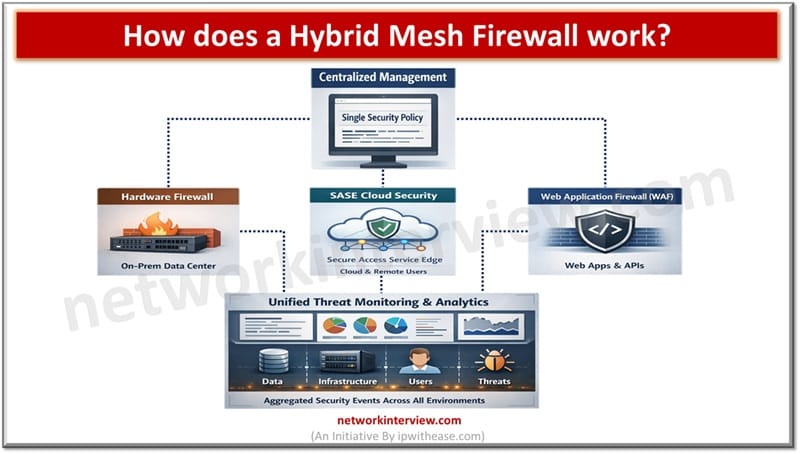
Hybrid mesh security architecture is all about centralized management and single policy enforcement to facilitate security policy creation, deployment and management with ease. It integrates security controls of different data center deployments into a single policy which can be applied across different environments – hardware firewall, SASE and Web application security firewalls. Hybrid mesh aggregates events across multiple deployments into a single view to provide a clear and contextualized view of data, infrastructure, users and threats landscape.
Why do we need Hybrid Mesh Firewalls?
The hybrid mesh firewall terminology was coined by Gartner to define solutions for unified management of security across hybrid networks and mixed deployments. Modern enterprises span across on-premises, cloud, branch offices and remote workforce which creates multiple challenges when it comes to managing traditional firewalls dispersed across networks. Hybrid mesh firewalls are needed when:
- Management complexity – 53% of organizations are struggling with managing multiple security tools or tools sprawl. Management overhead is further increased when different vendor firewalls or models are being deployed.
- Limited cross site visibility – standalone firewalls cannot effectively give insight into lateral threats in an enterprise landscape such as ransomware attacks etc.
- Multi-cloud and hybrid environments – policies need to be consistently applied across on-prem, cloud and remote workers which is troublesome without centralized management in place.
- Evolving threat landscape – as new threats are emerging, aggregation and correlation becomes important to derive the meaningful threat insights
Use Cases of Hybrid Mesh Firewall
- Multi-site or hybrid working – remote, branches, headquarters employees need to have uniform protection without the need to deploy multiple isolated security firewalls
- Multi-cloud security – consistently applied security policies across multiple clouds such as AWS, Azure and GCP
- Branch and remote working security – zero touch provisioning for remote workers and branches for quicker deployments and centralized management
- IoT and DNS protection – Enabling correlation across security tools (Firewalls) to identify anomalies and detect threats
Comparison: Traditional Firewall vs Hybrid Mesh Firewall
Feature | Traditional Firewall | Hybrid Mesh Firewall |
| Architecture | Centralized security model (perimeter-based) | Distributed security model across environments |
| Deployment Location | Typically deployed at network edge or data center perimeter | Deployed across on-premises, cloud, branch, and remote environments |
| Security Approach | Protects internal network from external threats | Provides consistent security across all environments (on-prem + multi-cloud) |
| Scalability | Limited scalability; hardware upgrades required | Highly scalable; cloud-native and software-based scaling |
| Cloud Support | Limited or requires additional configuration | Designed for multi-cloud and hybrid cloud environments |
| Traffic Inspection | Inspects north-south traffic (incoming/outgoing) | Inspects both north-south and east-west traffic |
| Remote Workforce Support | Requires VPN for remote access | Built-in secure remote access and zero-trust integration |
| Management | Separate management per device/location | Centralized policy management across environments |
| Flexibility | Hardware-centric, less flexible | Software-defined, |
Tag:Security

You may also like