Table of Contents
A page ranks well. It’s optimized, it sits in a good position, and it gets steady traffic from search.
Then someone asks ChatGPT or Perplexity the exact question that the page answers. Nothing. Not a single mention of the site.
The page had been ranking well for some time, and it was properly optimized and in a good position in the search results. It was receiving a steady amount of traffic from the search engines.
Then someone asked a question related to the page in ChatGPT, and it got no mention of the site in the response. They asked the same question in Perplexity, and again, it got no mention of the site in the response. This was not a problem with the search engines, this was a problem with how the Large Language Models read websites.
So the big question for all of us who are now choosing between a traditional CMS and a Headless CMS is: Does it matter? And the answer to that question is yes. But not for the reasons that you might expect.
How LLMs Actually “Read” a Website
LLM-based retrieval systems can read visible HTML, structured data, and metadata on a website. That distinction is exactly why picking from the top CMSs for LLMs matters, since these retrieval systems don’t process a page the same way a traditional search bot does.
In a detailed technical overview, Averi.ai explains how such systems work and why dynamically loaded JavaScript content is not read by default unless a special website crawler is used to render the JavaScript on a server first.
What an LLM “reads” off a website are visible elements of a page, such as the page title, the first couple of hundred words of body text, and even clearly structured answer blocks. If a website contains a lot of content that is loaded by a client (JavaScript) without being server-rendered first, the content of that website might not even be “read” by the LLM.
In terms of the structured data, again, it’s common for a web page to contain some form of schema markup, such as schema.org attributes, for example. This data describes the content of the page in a format that can be read by search engines, such as whether a page about “apple” refers to the fruit or the company behind iPhone devices.
Microsoft also recently wrote about schema.org markup in Bing’s AI-powered search results. A few weeks ago, a journalist wrote about Bing’s AI-powered search results for news sites and how Bing uses schema.org markup to better understand web pages.
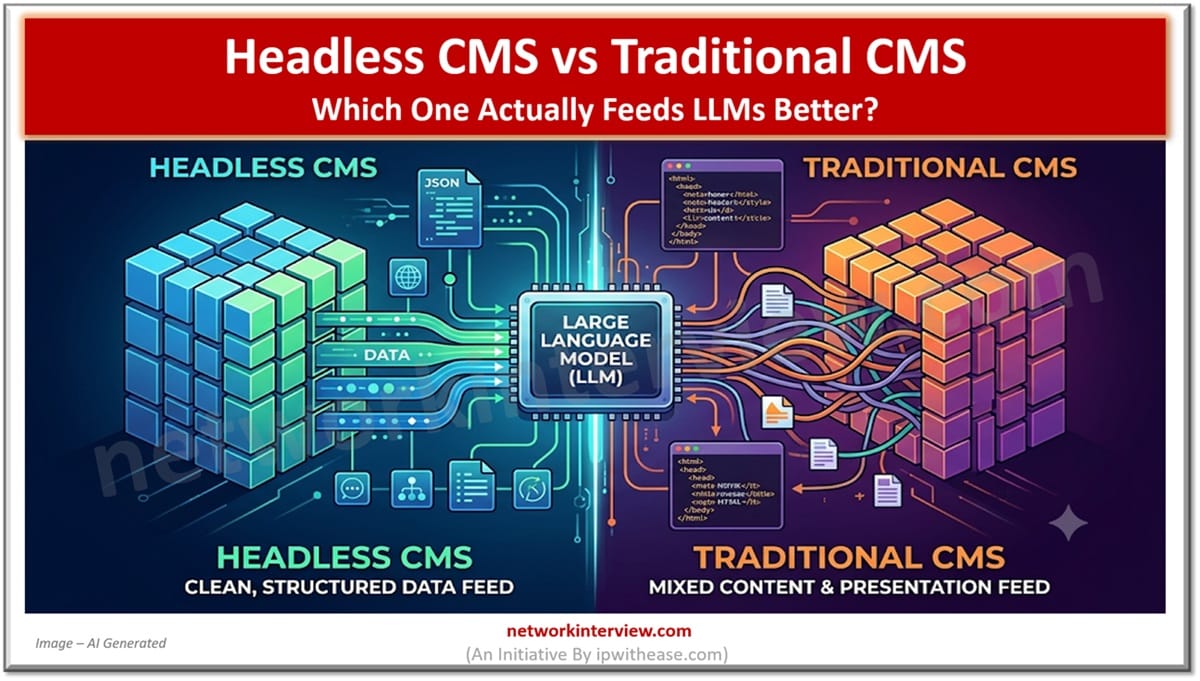
But then again, the two types of CMS platforms are fundamentally different in how they deliver content. Traditional systems couple the content with the presentation, i.e. the server delivers a fully styled page to the user, while a headless system delivers the content through an API, i.e., as structured JSON, which then can be used by any number of frontends, including websites, mobile applications, etc. Increasingly, though, that architectural choice is being reframed entirely by a best AI-ready CMS, which handles both structured delivery and AI-readiness natively.
Delivering Content with Traditional CMS Platforms
Most websites today are built with a Content Management System (CMS). A CMS is a system that allows users to add, modify, and remove content from within a web-based interface. Typically, a CMS marries the content of a website with the presentation of that content. In other words, the end user sees the content mixed up with the theme (template) of a website. The content is thus buried within the HTML of a page. That’s what a Large Language Model (LLM) also ‘reads’.
Content can get lost within the Theme’s HTML, particularly with very feature-rich Templates, and an abundance of Plugins such as SEO, Forms, etc. Additionally, the generated HTML for every page will be inconsistent.
This is not to say that Traditional CMS’s present too many problems for Large Language Models, as they do have a huge amount of development history, and large numbers of skilled developers, all able to assist with troubleshooting any issues that may arise. Additionally, many Plugins, such as those listed above, will include support for schema.org structured data.
On the other hand, there is plenty of history behind traditional CMS platforms. There are many experienced developers who are familiar with the typical issues that occur with these systems. In addition, there are many plugins for various functions that also include support for schema.org markup.
Content that is hosted using a Headless CMS is delivered as structured JSON through an API. A Website, Mobile App or other front-end can then be built to retrieve the data from the API and use it to render content to users.
As the content is delivered in a structured format, it is often easier to ensure that consistent structured data is exposed from the API. Of course, this does not automatically mean that all of the structured data will be correct, but it is a lot easier to get it right as it is a core part of the setup.
However, the content has to be server-rendered, too. And this is where the effort really is. A headless CMS gives you fewer structural barriers than a traditional CMS, but it’s not a shortcut.
Which Architecture Actually Wins for LLM Visibility
Here is a summary of the leading Content Management Systems (CMS) for LLMs.
Traditional platforms often have inconsistent content structure in templates, limited or plugin-dependent API access, and unevenly structured data that may require plugin support. But, they often render pages server-side out of the box, and are therefore crawler-friendly once they have been properly configured.
For Headless CMSes, the structure of the content is defined by the API schema. This means that the structure of the structured data of a headless CMS is generally consistent across all content types. As API data, the structured data can be sent to any number of frontends, such as websites, mobile apps, etc.
For a Headless CMS, the issue of how to render the content for a crawler is dependent on how the frontend for the API is built. Therefore, the crawler friendliness of a Headless CMS is only strong by default if the implementation of the frontend is done well.
So, in summary, there is a structural advantage of Headless CMS platforms in terms of clean structured data, but this can also be achieved with traditional CMS platforms and is not a given with Headless sites. So while the structural advantage of Headless platforms is quite high, it does not automatically mean that you will reach that advantage.
Here are a few things to keep in mind that are more important than the actual platform used.
- Add schema markup across every content type, not just a handful of key pages.
- Don’t rely on JavaScript for your main content. Make sure that this is also server-side rendered.
- Keep your heading structure semantic and consistent, since LLMs weigh early, clearly labeled content heavily.
- Expose a structured feed or API wherever your CMS allows it.
At the end of the day, the work needed for LLM visibility does not change whether you’re working with a headless CMS or a traditional one: clean, structured data for the LLMs to consume.
A badly configured headless CMS will lose to a well-optimized traditional CMS every time. The work and trade-offs between traditional and headless architectures are less relevant than the actual work done with the chosen architecture.