Difference between AODV Routing Protocol and DSR Protocol
An ad hoc network or Mobile ad hoc network refers to a network connection established for a single session and does not require a router or a wireless base station. It does not depend on a pre-existing infrastructure such as routers in wired networks or APs in managed wireless networks. This is divided into reactive and proactive routing protocols. This Reactive routing protocol or on-demand routing is further sub divided into two categories:
- AODV Routing Protocol
- DSR Protocol
Introduction to AODV Routing Protocol
Ad-hoc On-Demand Distance Vector (AODV) is a reactive routing protocol where routes are created only when they are required. Main application of AODV is mobile network. It uses routing table setup follows one entry for each destination. Sequence numbers are used to determine an up-to-date path to a destination. Every entry in the routing table having a sequence number. The sequence number act as a route time stamp, ensuring freshness of the route. Upon receiving a RREQ packet, a node compares its sequence number with the sequence number in the RREQ packet. If the sequence number already greater than that in the packet, the existing route is more up-to-date.
Introduction to DSR Protocol (Dynamic Source Routing)
Dynamic Source Routing is an On-Demand routing protocol where the route is calculated only when it is required. Application of DSR is in multi hop ad hoc networks of mobile nodes. DSR’s main feature is self-organized and self-configured network without any central administration and network setup. It uses no periodic routing messages. Thus it reduces bandwidth overhead and conserved battery power and also huge routing updates.
Comparison : DSR vs AODV
- Both are on demand routing protocols.
- AODV works on Hop by Hop routing whereas DSR on source routing.
- In DSR, route cache entries do not have lifetimes whereas AODV route table entries do have lifetimes.
- DSR uses routing cache aggressively and maintains multiple route per destination where as AODV uses one route per destination.
- In DSR, multiple route per destination requires high storage space where as AODV uses very less space because it uses one route per destination.
- DSR does not have any of the mechanism to expire stale route in the cache whereas AODV is more conservative, the fresher route is always chosen.
- Route discovery cycle is very frequent in AODV and less in DSR.
- Both have scalability problem because of routing.
- DSR uses source routing but AODV uses a table driven routing framework and destination sequence to prevent loop and determine route freshness.
- DSR does not rely on any timer based activities but AODV based on timer activities.
- Bandwidth usage is efficient in AODB but DSR does not have this capability.
- In case of AODV, routes in routing table are deleted when not in use even they are valid routes. However, in scenario of DSR routes are still installed in routing table when they are not valid or staled.
- From performance prospective in mobility scenario- AODV is very good, DSR is very poor.
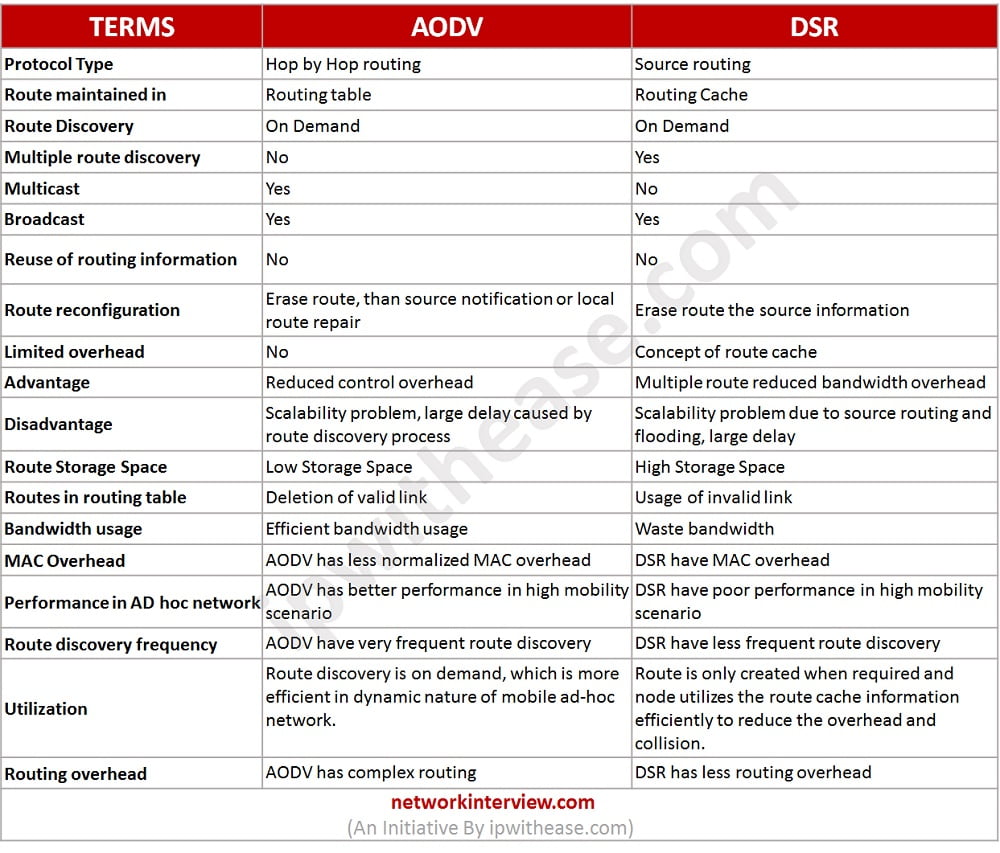
DIFFERENCE BEWEEN AODV AND DSR SUMMARIZED:
TERMS | AODV | DSR |
| Protocol Type | Hop by Hop routing | Source routing |
| Route maintained in | Routing table | Routing Cache |
| Route Discovery | On Demand | On Demand |
| Multiple route discovery | No | Yes |
| Multicast | Yes | No |
| Broadcast | Yes | Yes |
| Reuse of routing information | No | No |
| Route reconfiguration | Erase route, than source notification or local route repair | Erase route the source information |
| Limited overhead | No | Concept of route cache |
| Advantage | Reduced control overhead | Multiple route reduced bandwidth overhead |
| Disadvantage | Scalability problem, large delay caused by route discovery process | Scalability problem due to source routing and flooding, large delay |
| Route Storage Space | Low Storage Space | High Storage Space |
| Routes in routing table | Deletion of valid link | Usage of invalid link |
| Bandwidth usage | Efficient bandwidth usage | Waste bandwidth |
| MAC Overhead | AODV has less normalized MAC overhead | DSR have MAC overhead |
| Performance in AD hoc network | AODV has better performance in high mobility scenario | DSR have poor performance in high mobility scenario |
| Route discovery frequency | AODV have very frequent route discovery | DSR have less frequent route discovery |
| Utilization | Route discovery is on demand, which is more efficient in dynamic nature of mobile ad-hoc network. | Route is only created when required and node utilizes the route cache information efficiently to reduce the overhead and collision. |
| Routing overhead | AODV has complex routing | DSR has less routing overhead |
 | ||
Download the difference table here.
Conclusion
Analysis on both protocols infers that Packet delivery ratio for AODV is better than DSR in high mobility. AODV has more end to end delay as compared to DSR. Additionally, AODV incurs more routing overhead in contrast to DSR. Finally, energy consumption in DSR is almost constant as we increase the number of nodes which is opposing to AODV which increases as no. of nodes increase.