Before discussing difference between Database and Data Warehouse, let’s understand the two terms individually.
Data Warehouse
The data warehouse is devised to perform the reporting and analysis functions. The warehouse gathers data from varied databases of an organization to carry out data analysis. It is a database where data is gathered, but, is additionally optimized to handle the analytics. The reports drawn from this analysis through a data warehouse helps to land on business decisions.
Data warehouse is an integrated view of all kinds of data drawn from a range of other databases to be scrutinized and examined. It helps to establish the relation between different data that is stored in an organization to further build new business strategies. Analysis or data processing in a warehouse is done by intricate interrogation and questions. It is an Online analytical processing (OLAP) that takes use of standard languages to handle relational data where the data is stored in a tabular form only including rows and columns, indexes, etc. The data stored in a warehouse is applicable to many functions and databases.
The data warehouse is well developed and optimized for amassing and collecting large quantities of data for analyzing it. Data in a warehouse is standardized for boosting the response time for analytical queries and making the data normalized to be used by businessmen. Data analysis and business reporting in a warehouse can be done in many different ways like diagnostic, predictive, descriptive or prescriptive. Since warehouse includes related data all in one place, it uses lesser disk space than databases for those related data. A data warehouse can also store historical data while also real time or current data for handing over most recent information.
Database
Database includes information or data in a tabular form arranged in rows and columns or chronologically indexed data to make access easy. All, whether small or large enterprises require databases to store their information and a database management system that handles and manages the large sets of data stored. For instance, customer information database or product information or inventory database are all different databases for storing information about the customers and products respectively.
The data in a database is stored only for access, storage and data retrieving purposes. There are different kinds of databases available like CSV files, XML files, Excel Spread sheets, etc. Databases are often used for online transaction processing which allows adding, updating or deleting the data from a database by the users. Database makes the task of accessing a specific data very easy and hassle free to carry out other tasks properly. They are like day to day transaction system of data for any organization.
Such transactional databases are not responsible for carrying out analytics or reporting tasks, but, are only optimized for transactional purposes. Database only have a single application of carrying one kind of data in an organized tabular format. Real-time transactions are also applicable in a database which is developed for speedy recording of a new data, e.g. name of a new product category in the product inventory database. Only read and write operation can be carried out in a database and response time is optimized for a few seconds. No analytical task can be initiated in a database as it blocks all other users out of it and slows down the entire performance of a database.
Related – Data Warehousing and Data Mining
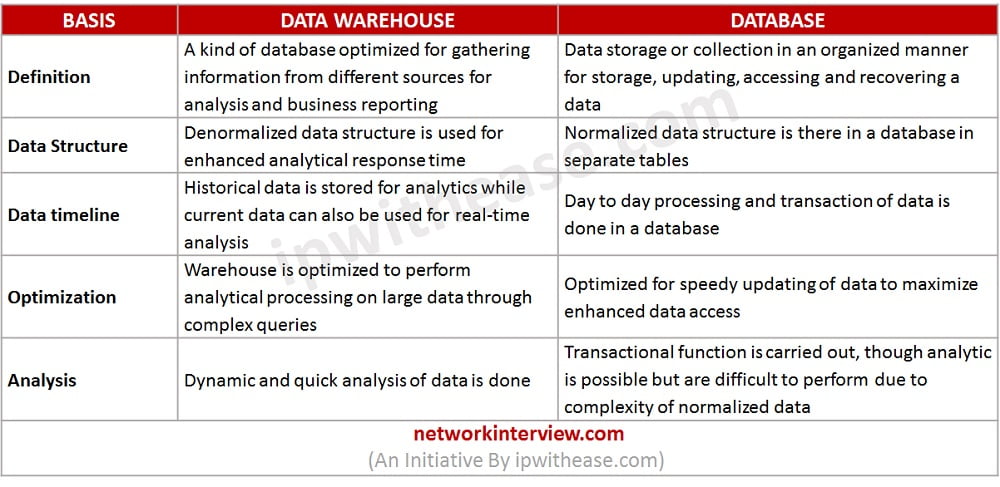
Comparison Table: Database vs Data Warehouse
Below table summarizes the differences between Database and Data Warehouse:
BASIS | DATA WAREHOUSE | DATABASE |
Definition | A kind of database optimized for gathering information from different sources for analysis and business reporting. | Data storage or collection in an organized manner for storage, updating, accessing and recovering a data. |
Data Structure | Denormalized data structure is used for enhanced analytical response time. | Normalized data structure is there in a database in separate tables. |
Data timeline | Historical data is stored for analytics while current data can also be used for real-time analysis. | Day to day processing and transaction of data is done in a database. |
Optimization | Warehouse is optimized to perform analytical processing on large data through complex queries. | Optimized for speedy updating of data to maximize enhanced data access. |
Analysis | Dynamic and quick analysis of data is done. | Transactional function is carried out, though analytic is possible but are difficult to perform due to complexity of normalized data. |
 | ||
Download the difference table: Database vs Datawarehouse
Continue Reading:
Business Intelligence vs Data Warehouse