
Why Node.js is Perfect for Real-Time Application Development
Node.js is a popular choice among modern developers to create a variety of applications. For building real-time applications Node.js is widely used as it allows developers to create or build feature rich and high performance applications which require real-time functionalities.
Evaluation in the digital landscape transformed the way today’s businesses operate. Enterprises are deploying real-time applications characterized by real-time collaboration and instant communications. Choice of right technology becomes crucial here so scalable and high performing business applications can be built.
Node.js is a single thread model and uses fewer resources and it has a variety of tools available which makes it easy to optimize business applications and using caching the load times are significantly reduced.
In this article we will learn about how Node.js is the best choice for real-time application development and its key characteristics and use cases.
Overview of Node.js
Node.js is an executional model run on a single thread to enable handling of multitude of concurrent client requests in an efficient manner. Requests are handled and processed for clients on a web based interface.
Node.js development is elastic, having a set of libraries, packages and third party APIs bundled to extend the capability of application functionality. Business applications having customization flexibility is what node.js achieves.
Many business applications use Node.js in the real world and are widely popular such as LinkedIn, Yahoo, Netflix, Uber, PayPal and Groupon.
Understanding Real-time Applications
Node.js has a powerful architecture with scalability and flexibility. Highly resilient architecture and capability to handle heavy workloads which is a common requirement of real-time applications. It makes a popular pick for developers to build business applications, specifically the real-time ones.
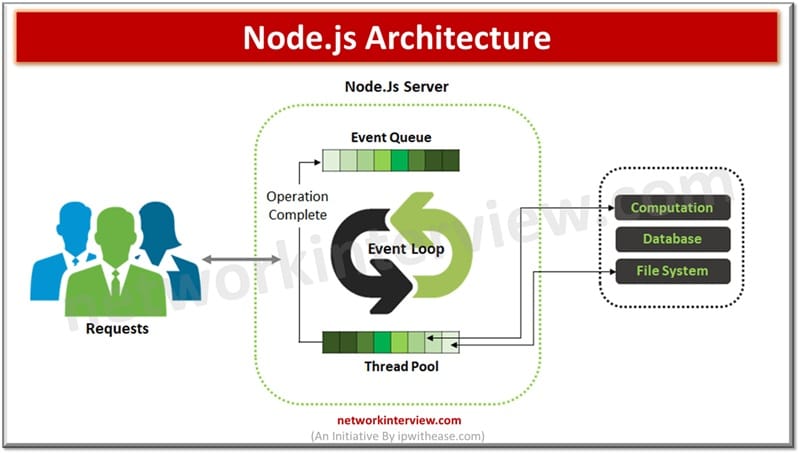
The actual power of Node.js lies in its asynchronous and event-driven execution model which allows processing of requests without blocking current ones. It can differentiate between multithreaded architecture of different technologies such as JSP, Spring, ASP.NET etc.
Key Features of Node.js
- Usage of fewer threads means low memory and resource consumption
- Flexibility is achieved with asynchronous and concurrent capability
- Additional threads are not required to manage increased requests due to request handling in node.js is done using event loop functionality support
- Multiple concurrent requests are handled in efficient manner and any additional requirements can be addressed effortlessly
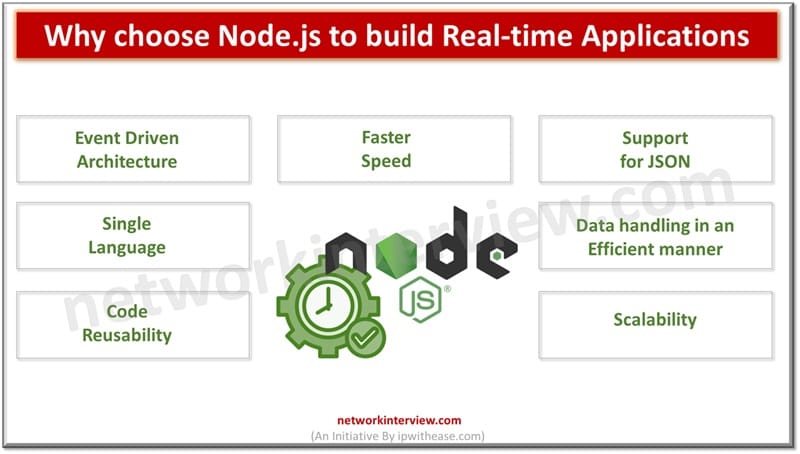
Why choose Node.js to build Real-time Applications
Real-time application characteristics are flexibility, scalability, swift-response and user friendliness as these are the key metrics for success of real-time applications. Node.js empowers programmers / developers in building real-time applications using its best feature set and tools. Let’s look at Node.js capabilities which make it a value preposition to build real-time applications.
- Event Driven Architecture – Asynchronous and event driven architecture of node.js makes it an ideal solution to build real-time applications which need to handle multiple users requests in large numbers.
- Single Language – Node.js is based on JavaScript programming language and unlike other technologies there is no need to have different languages for front-end and back-end. There is a single language to make data movement between front-end and back-end (Client and server locations). Simplifies development efforts for developers as they need to work only on a single programming language leading to synchronized efforts.
- Code Reusability – Node.js allows creation of React modules and reuse them using Brit in other projects. NPM is utilized for access and management of packages across projects.
- Faster Speed – with node.js it is easier to build high-performing real-time applications. Node.js is built on chromo v8 JavaScript engine where JavaScript code is compiled directly into machine language thus reducing execution time. Multiple concurrent requests are supported with Non-blocking I/O operations.
- Support for JSON – Data exchange between server and client is simplified using JSON in real-time applications. With Ruby on rails and PHP which can also use JSON it requires conversion into a binary model that is not true as with JavaScript no conversion is needed here.
- Data handling in an Efficient manner – Real-time response is provided to end users as node.js is capable of handling multiple user requests efficiently as data is processed in streams and chunks rather than loading entire data sets into the memory. Information can be added in real-time into Node.js applications on fly making them run faster without any glitches or delays.
- Scalability – with Node.js built applications they can be scaled vertically or horizontally without any complexities. Real-time applications can be scaled horizontally by adding more nodes and in vertical scaling more resources can be integrated into a single node by developers.