Top 10 Network Threats & How NDR Detects Them
If you’ve spent any time on a network, you already know this: every attacker, no matter how sophisticated, has to communicate. They have to move. They have to transfer data. And that means they touch the network.
That’s where Network Detection and Response (NDR) steps in. It doesn’t wait for known signatures. It watches behavior across east-west traffic, north-south flows, encrypted sessions, DNS patterns, and flags what doesn’t belong.
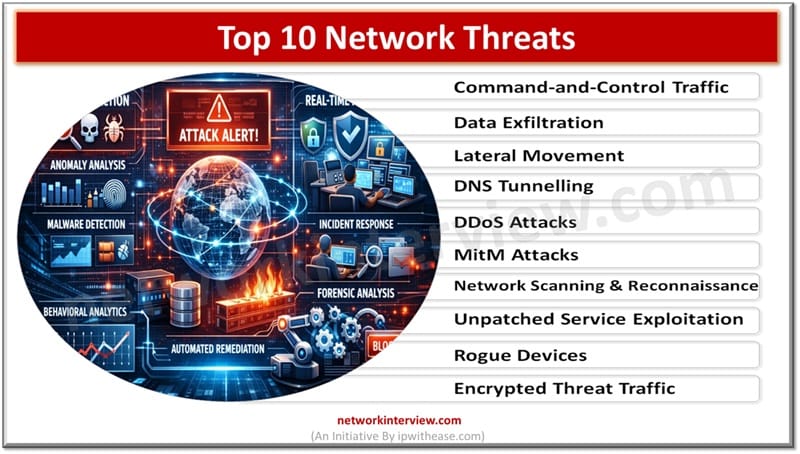
Let’s walk through the top 10 network threats in 2026 and how NDR actually detects them.
Top 10 Network Threats of 2026
1. Command-and-Control (C2) Traffic
Command-and-control traffic is how attackers maintain control over a compromised device. This traffic frequently masquerades as:
- DNS lookups to newly registered domains.
- Periodic HTTPS requests at fixed intervals.
- Encrypted outbound connections to rare external IPs.
As the C2 traffic is encrypted and outbound, traditional perimeter tools often treat it as normal and mistakenly allow data exfiltration. But subtle indicators, like beaconing intervals or unusual destination patterns, can reveal malicious C2 activity.
2. Data Exfiltration
Data exfiltration involves unauthorized transfer of sensitive information outside the organizational network. It starts with ransomware or malware attack campaigns, where attackers first steal the data before encrypting the systems. Exfiltration may happen in bulk or in slow moving outbound sessions.
3. Lateral Movement
After compromising one machine, attackers begin pivoting across the network. They test credentials, probe file shares, and attempt remote logins to see how far those stolen privileges will take them.
In many real-world investigations, this stage is where security solutions may miss the intrusion entirely, as the traffic often uses legitimate methods to move.
Nothing appears malicious at first glance, but there are abnormal patterns that give it away.
4. DNS Tunneling
It is a technique in which malicious data is sent from applications or protocols by hiding inside Domain Name System (DNS) queries and responses. DNS traffic is a part of internet and is widely used by browsers, systems, and email services. It is lightly examined and widely permitted, allowing attackers to leverage it for hidden communication.
5. Distributed Denial-of-Services Attacks (DDoS)
DDoS attacks aim at bringing down the network resource by overwhelming it with large traffic volume.
Modern DDoS campaigns can be high-volume floods targeting bandwidth or low-and-slow application-layer attacks that exhaust login portals, APIs, or specific services without triggering immediate alarms.
The real challenge is recognizing when a DDoS event is masking something more targeted happening in parallel.
6. Man-in-the-Middle (MitM) Attacks
In a MitM attack, instead of breaking in, attackers insert themselves quietly between two communicating parties. They exploit weak protocols, misconfigured certificates, or unsecured Wi-Fi environments.
In quieter cases, they simply eavesdrop — capturing session tokens or credentials in transit. In more active attacks, they manipulate traffic, replay authentication tokens, or impersonate one side of the conversation.
Because communication still “works,” victims often have no idea interception is happening.
7. Network Scanning and Reconnaissance
Before exploitation begins, attackers map the environment. They scan open ports and exposed services to see what responds. Scanning in itself is not harmful, but it is the earliest visible sign that someone is attempting an intrusion.
8. Unpatched Service Exploitation
Software patches defend against constantly evolving cyber threats and fix vulnerabilities. However, organizations often fail to keep up with the patches, which then become the entry point for attackers.
Once vulnerability is exploited, threat actors begin scanning internal networks looking for systems to attack.
Organizations often struggle to patch immediately, allowing attackers to take advantage of that delay window.
9. Rogue Devices
Rogue devices could be an unmanaged IoT camera, a personal laptop connected to a corporate switch, or a forgotten test server still plugged into the network.
Because these devices aren’t properly monitored or hardened, they become soft entry points. In real enterprise environments, attackers often look for the path of least resistance and unmanaged assets provide exactly that.
10. Encrypted Threat Traffic
Encryption has become the default for modern communication. That’s good for privacy — but it creates blind spots for defenders.
Attackers increasingly hide malicious activity inside TLS sessions:
- Command-and-control traffic.
- Data exfiltration.
- Credential harvesting.
Traditional tools that rely on signature inspection struggle when payloads are encrypted. Detection now depends less on content and more on behavior.
How NDR Helps Detect and Respond to Network Threats
Network Detection and Response (NDR) focuses on analyzing network traffic — both north-south and east-west — to detect abnormal behavior in real time.
Here’s how NDR strengthens network security:
1. Behavioral Detection Instead of Signatures
NDR establishes baselines of normal network behavior and flags deviations — helping detect zero-day attacks and insider threats.
2. Visibility into Encrypted Traffic
Without decrypting content, NDR analyzes traffic patterns, metadata, and anomalies to detect suspicious activity hidden in HTTPS.
3. Detection of Lateral Movement
NDR monitors internal traffic between devices to uncover ransomware spread, credential misuse, and privilege escalation.
4. DNS and Beaconing Analysis
It identifies suspicious domain queries, periodic beaconing, and covert communication channels.
5. Faster Investigation & Response
NDR platforms reconstruct attack timelines, allowing SOC teams to answer:
- When did the attack begin?
- Which systems were involved?
- What data moved?
- Was lateral movement successful?
Conclusion
Network threats aren’t slowing down. They’re getting faster, quieter, and more encrypted. But attackers still need to communicate. They still need to move. They still need to transfer data. And that means they must touch the network.
Robust solutions provide deep visibility in the network, detect abnormal behavior across traffic flows, and respond immediately to safeguard the organization and its assets. It stands out with full packet capture, metadata enrichment, and advanced detection to uncover hidden threats.
Tag:Security

You may also like

Why Node.js is Perfect for Real-Time Application Development