Table of Contents
AI works on input and output which goes and comes out via prompts but often the question comes how much output generated via AI systems is relevant and satisfactory? It is like I am asking for the moon and you are giving me something which is not even relevant to the purpose.
The question arises here therefore if there is a smarter and efficient way to interact with AI technology and systems?
Prompt engineering is the answer here!
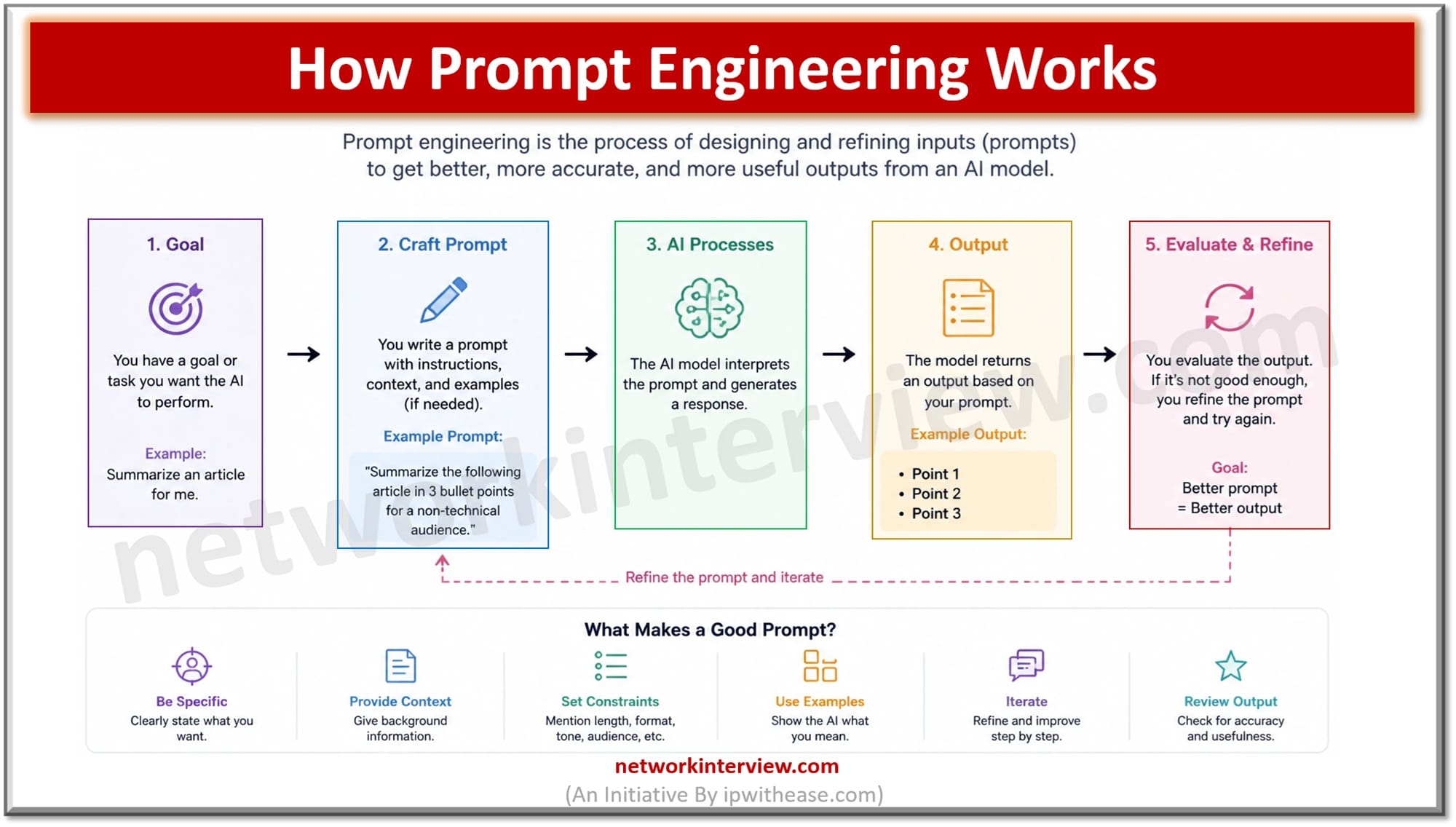
Prompt engineering creates more meaningful carefully crafted text based prompts which produce more relevant and accurate results. The results are more reliable while making AI tool more user friendly. Prompt engineering is an integral part of generative AI technology which has revolutionized our interaction with AI technology.
In today’s article we will understand about prompt engineering, its emergence and evolution, key benefits and uses.
Prompt Engineering
Prompt engineering is an emerging discipline focused on the careful design, refinement and optimization of prompts, along with the data structures that support them. It involves systematically crafting prompts that guide generative AI systems toward specific, useful outputs, making communication between people and AI more effective. It also includes ongoing evaluation and categorization of prompts, so that outputs stay effective and relevant over time. Up-to-date prompt libraries improve efficiency, help maintain accuracy and encourage knowledge sharing among prompt engineers. As AI is getting integrated deeper in our daily lives the importance of prompt engineering is increasing. Chatbots, virtual assistants and voice-activated devices are among the systems that benefit most from well-designed prompts.
How is Prompt Engineering defined?
In simple terms, prompt engineering comes into play whenever we interact with generative AI (GenAI) models such as large language models (LLMs). A prompt is entered into the GenAI system, and the LLM processes it to generate an output. Because LLMs can’t reliably fill in missing context or guess what the user really meant, prompt engineering is needed to craft clear, well-structured prompts that produce relevant, high-quality results.
Prompt engineering came into existence due to the need for better communication with AI systems.
Key Elements of Prompt Engineering
The development of commands which suit the need of AI system and create more meaningful prompts works on certain design principles which follow rules of human language such as:
- Clarify which means no unambiguous prompts
- Context which means adequate information to prompt
- Precision which means desired outcome or response
- Adaptability which means capability to work with various AI models
Expansion of knowledge base: This means training AI to enable to generate required output using specific data types and enhance output and this can be achieved using several techniques as under:
- Adding knowledge via prompts – direct input to AI system via prompt
- Layered knowledge addition creates a supplementary layer which sits on main database or AI model
- Database checkpoints is useful in text to image AI models
- Fine-tuning involves tweaked AI models for more relevant outputs
- Embedding techniques involves data representation in such a manner that AI model produces more relevant output
Prompt Library maintenance: Optimized and tested prompts are stored in the library to refine and expand knowledge of AI models.
Optimization, evaluation and categorization of prompts ensure up to date prompts
Prompt Engineering Benefits
- Optimization of AI model – Prompt engineering ensures AI models produce more accurate and relevant outputs and system performance is improved with enhanced task handling capability.
- Systems flexibility and adaptability is increased as more refine prompt enable better outputs
- Reduction in costs and resources allocation as improved workloads reduce manual interventions
- Reachability of AI solution to market is enhanced as development process is speed up
- Information retrieval is improved which allows systems to provide more relevant and context aware output
- Personalized experiences enrich user experience which suits end user needs and requirements