FortiManager is a centralized management platform made by Fortinet for administering lots of Fortinet devices (mainly FortiGate firewalls) from one place. Instead of logging into each firewall individually, FortiManager lets you manage them all through a single console. FortiManager comes in different models (deployment options), not just one hardware box, like – FortiManager Hardware Appliances, FortiManager Virtual Machine (VM), FortiManager Cloud.
A robust firewall is the first line of defense in any network. A good firewall provides an effective defense against cyber threats.
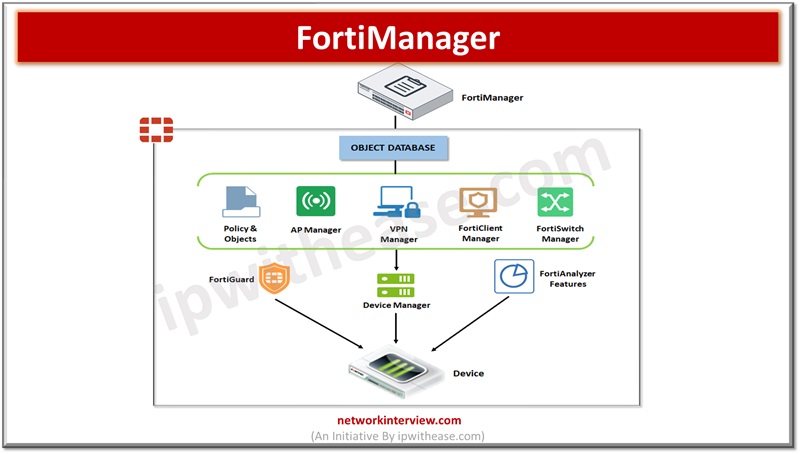
Fortigate FortiManager centralizes the management of Fortinet based security infrastructure components. Deployment of new devices, distribution of updates, installation of security policies across managed devices, all can be achieved using a common interface.
Devices discovery, auditing, group based management, complex mesh and STAR VPN networks can be managed resulting in drastic reduction in management costs. It is complemented by FortiAnalyzer for log aggregation and reporting.
In today’s article we will understand the difference between various FortiManager models, their key differences, and how they are used.
What is a FortiManager
FortiManager enables centralized management of Fortinet assets across the networks for security infrastructure. FortiManager can be scaled to manage thousands of Fortinet devices and agents. All assets can be managed centrally or in a distributed manner. The FortiManager major capabilities are:
- Centralized or distributed management – FortiManager allows centralized or distributed management of devices and agents where some tasks are handled locally
- Global object database – reuse of common configurations across devices
- Appliance based centralized management – no third party Operating system or hardware required here
- Automated devices provisioning and policy management – Policy maintenance across all managed assets.
FortiManager Models Comparison
| Features | FortiManager Virtual Appliance | FortiManager-100C | FortiManager-400B | FortiManager-1000C | FortiManager-3000C | FortiManager-5001A |
| Capacity | Network devices supported 5000 | Network devices supported 20 | Network devices supported 200 | Network devices supported 800 | Network devices supported 5000 | Network devices supported 4000 |
| Agents supported 120,000
| Agents supported 2500
| Agents supported 10,000
| Agents supported 25,000
| Agents supported 1,20,000
| Agents supported 100,000
| |
| Administrative domains | 200 | 10 | 10 | 50 | 200 | 100 |
| Administrative Web Portals | 100 | 10 | 10 | 50 | 100 | 100 |
| Web portal users | 4000 | 200 | 200 | 500 | 4000 | 4000 |
| Disk storage capacity | 60 GB | 1 TB | 500 GB | 1 TB | 2 TB | 80 GB |
| High availability | Yes | Yes | Yes | Yes | Yes | Yes |
| Hot swappable power supply | Yes | No | No | No | Yes | Yes (In-built in Chassis) |
| 10/100 Ethernet | 1 | No | No | No | No | |
| 10/100/1000 Ethernet | 2 | 4 | 4 | 4 | 2 | |
| Security | Antispam, Antivirus, Intrusion prevention, Vulnerability management, Web filtering | Antivirus, Intrusion prevention, Vulnerability management | Antivirus, Intrusion prevention, Vulnerability management | Antispam, Antivirus, Intrusion prevention, Vulnerability management, Web filtering | Antispam, Antivirus, Intrusion prevention, Vulnerability management, Web filtering | Antispam, Antivirus, Intrusion prevention, Vulnerability management, Web filtering |
| Device type | Virtual appliance | Hardware appliance | Hardware appliance | Hardware appliance | Hardware appliance | Hardware appliance |
| Features | Single interface configuration | Single interface configuration | Can manage large number of devices | Enterprise grade management appliance | Large enterprise wide deployments | |
| Policy based management | Policy management | Edit, create and deploy security policies | Devices grouping based on geo or functional domains | Centralized policy, segmentation, automation, scripting | ||
| Automated deployment of devices and agents | Centralized updates | Secure SD-WAN deployment | Policy based automated provisioning | Content delivery and automated updates | ||
| Secure SD-WAN deployment | Device and policy auditing capabilities | Zero touch provisioning | Re-use of common configurations | VPN management, | ||
| Role based access control | Automation via REST API and scripts | Automation via REST API and scripts | Security fabric integration, complex mesh and STAR VPNs management | |||
| Supports High availability | Multi-tenancy administrative domains supported | Complex STAR and Mesh VPN management | Clustering supported for increased capacity | |||
| Automation of firmware updates | SSL VPN configurations | |||||
| Use cases | Private cloud such as VMware, Hyper-V, KVM etc. | Small enterprises | Mid-size deployment s | On premises deployment | On premises deployment | On premises deployment |
Download: FortiManager Models Comparison Table
Continue Reading
Top 7 Reasons to Choose FortiGate over other Firewalls
FortiAnalyzer vs Panorama: Detailed Comparison