What is ASIC (Application Specific Integrated Chip) in Cisco?
Cisco ASIC is a custom-built chip designed by Cisco Systems to perform high-speed networking tasks like packet forwarding and switching efficiently in network devices.
Integrated switches designed for specific functions in networking are referred to as application specific integrated chips. These chips function like CPUs, but unlike CPUs they are not used for common processing like a CPU but these specialized chips handle advanced functions in networking.
High speed data packet forwarding, modern firewalls deep packet inspection technology, QoS management in networks, Bandwidth optimization in WAN using compression / de-compression and network address translation or NATing in Cisco devices are some of the common use cases of ASIC.
In today’s article we will understand about Application specific integrated chip (ASIC) in Cisco, its architecture, functions and uses.
Application Specific Integrated Chip (ASIC)
Application Specific Integrated Chip is a modern day technology introduced in Cisco switches for optimization, performance and to support advanced security features. ASIC is used widely in networking though it is an expensive affair but since they are designed to handle specific network tasks such as deep packet inspection capability widely used in modern day firewalls, high speed packet forwarding and routing, Network address translation, traffic optimization over WAN links by compression / de-compression of data packets and managing Quality of service (QoS) in networks, packet switching and routing in stateless firewalls are some of the popular use cases for ASIC.
Machine learning functions and the AI ecosystem also uses. The ASIC based Google Tensor processing units (GTPU) are used to accelerate machine learning functions and in orbit maneuvering during rocket movement to new orbit along with its payload.
ASIC design is highly complex though less energy it consumes being hyper-efficient. It uses Hardware description language e.g. Verilog. ASIC uses a special memory called Ternary Content-Addressable Memory or TCAM for storage of lookup tables (access tables, forwarding tables and Class of service (CoS) etc.
Architecture of ASIC
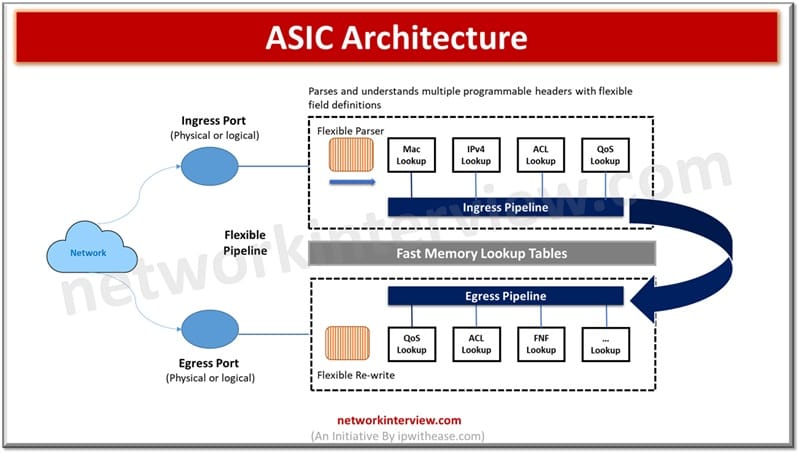
Application specific integrated chip is designed on a silicon microchip technology. A general purpose CPUs fast run random access applications whereas ASIC is designed for processing and forwarding network traffic and for that it requires constant searching of large memory tables which a normal CPU will not be capable of handling.
Cisco Silicon One unified architecture provides a high performance, scalable, low power consumption with large scale packet switching supports efficient routing and switching. It provides shared buffering, deep programmable AI pipelines and service provider applications.
Key Features of ASIC Architecture
- Unified Architecture – Multiple roles are taken up by ASIC – router and L2 switch, spine and leaf across diverse environments in data centers and campus networks.
- Multi-slice – it has multiple network processing engines which operate parallelly with their own resources connected via a high-speed crossbar fabric
- Programmable Pipeline – Advanced features such as segmentation, routing and advanced quality of service (QoS) supported without any change in underlying hardware
- Deep Buffering – AI training generates massive workloads which can be effectively handled with deep buffering
- High scale Throughput – 51.2 Tbps supported in routing and 800 G coherent optics with line-rate encryption
- Telemetry – Advanced on chip analytical capabilities enables real-time monitoring of networks devices
- Adaptability – varied speeds and density bulk support
- Consistency – API (SDK) and uniform feature set across line of products
- Efficiency – Power, scale and performance efficient
Tag:cisco

You may also like

Why Node.js is Perfect for Real-Time Application Development

Top 10 Network Threats & How NDR Detects Them