5 LinkedIn Post Secrets That Will 10x Your Visibility | Personal Branding
Most posts disappear into the feed within minutes. This guide gives you the exact formula — hook, structure, value, and CTA — to write posts that the algorithm rewards and real people actually read.
You’ve spent thirty minutes writing what felt like the perfect LinkedIn post. You hit publish, close the tab, and come back an hour later — four likes, two of which were your mum and your college roommate. Sound familiar? Here’s the thing: it probably wasn’t bad content. You just didn’t know the rules of the game you were playing.
LinkedIn is not a resume. It’s not a press release, and it’s definitely not Facebook in a blazer. It’s a professional network built around conversation — and its algorithm rewards content that sparks one. Understanding this single truth will change the way you write every post from here on out.
This guide breaks down exactly what makes a LinkedIn post perform — the structure, the psychology, the formats, and the habits. By the end, you’ll have a repeatable system you can use every single week.
Related: Why is it Hard to Get Hired ?
Why Most LinkedIn Posts Go Nowhere
Before we talk about writing, we need to talk about distribution — because a brilliant post that nobody sees is just a journal entry.
LinkedIn’s feed algorithm works on a simple but powerful principle: early engagement predicts total reach. When you post something, LinkedIn shows it to a small slice of your connections first. If those people engage — like, comment, share — within the first 60 to 90 minutes, the algorithm reads that as a signal of quality and pushes it to more feeds. If it sits silently, it gets buried.
This means your job when writing a LinkedIn post isn’t just to write something good. Your job is to write something that makes people want to respond — fast. That changes everything about how you should approach the craft.
60-90 | 3× | 70% |
| Minutes To Prove Your Post’s Worth To The Algorithm | More Reach When Posts Get Early Comments Vs Likes Alone | Of LinkedIn Content Is Consumed On Mobile — Format Matters |
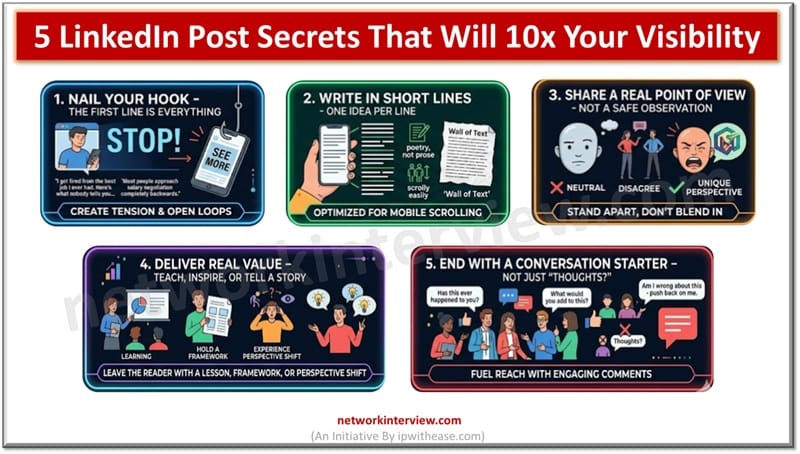
The 5-Element Formula for a High-Performing Post
Every LinkedIn post that consistently performs well shares five characteristics. Master these, and you’ll have a repeatable framework you can apply to any topic, any industry, any day of the week.
The Hook — Your First Line Is Everything
LinkedIn shows only the first one to two lines before the “see more” button cuts off your post. If your opening line doesn’t stop someone mid-scroll, they’ll never read the rest — no matter how good it is. A great hook is surprising, counterintuitive, relatable, or boldly specific. It opens a loop that the reader needs to close.
“I got rejected from a job I was overqualified for. Here’s what nobody tells you about that.” — This works because it creates tension and promises a payoff.
Short Lines — One Idea Per Line
Seventy percent of LinkedIn is read on mobile. Dense paragraphs are invisible on a phone screen. Write in short, rhythmic lines. Break your ideas apart. Give them room to breathe. This creates visual momentum — the reader keeps scrolling down instead of bouncing away. Think of it less like an essay, more like a poem.
A Real Point of View — Not a Safe Observation
The posts that go viral are never the neutral ones. They’re the ones where someone says something they actually believe — even if it’s slightly uncomfortable. Disagree with conventional wisdom. Take a stance. Be specific. Generic observations like “networking is important” generate nothing. Counterintuitive claims like “most networking advice is completely backwards” generate conversation.
Real Value — Teach, Inspire, or Tell a Story
Every post should leave the reader feeling like they got something. A lesson from a mistake. A framework they can use. A perspective shift. A story they can relate to. Before you post, ask yourself: “If someone reads this in 45 seconds, what do they walk away with?” If you can’t answer that clearly, the post needs work.
A Conversation Starter — Not Just “Thoughts?”
Comments are rocket fuel on LinkedIn. The more you get early, the more reach you earn. So end your post with a question specific enough to earn a real response — not a vague invitation that requires no effort to ignore. Make it easy and interesting to answer.
Instead of “Thoughts?” try: “Has this ever happened to you?” or “What would you add to this list?” or “Am I wrong — push back on me.”
Three Post Formats That Always Perform
You don’t need to reinvent the wheel every time you sit down to write. These three formats work consistently across industries, audiences, and topics. Rotate between them and you’ll never stare at a blank screen again.
The Lesson Post | The Contrarian Post | The Story Post |
| Share something you learned — from an experience, a mistake, a book, a conversation. Structure it as: what happened → what you learned → what readers can take away. This format builds credibility and gets saved. | Pick a piece of conventional wisdom in your industry and respectfully challenge it. “Everyone says X — here’s why I disagree.” These posts drive comments because people either agree passionately or want to debate you. Both are good. | Tell a short personal story with a professional lesson at the end. It doesn’t have to be dramatic — just real. A story about a failure, a pivot, or a surprising moment consistently outperforms almost everything else on LinkedIn. |
The Consistency Trap — And How to Escape It
Here’s where most people fall off. They write one solid post, get some traction, feel good about it — and then disappear for three weeks. Then one more post. Then silence for a month.
LinkedIn’s algorithm doesn’t reward sporadic brilliance. It rewards consistency. The more regularly you show up, the more your follower count grows, the more your posts reach people who don’t follow you yet, and the more your name starts showing up in feeds unprompted.
You don’t need to post every day. But two to three times a week is where the compounding effect kicks in. Here’s how to make that sustainable:
- Batch write your content. Sit down once a week and write three posts. Don’t edit as you go — just draft. Editing comes later. This separates the creative work from the critical work.
- Keep a running idea list. When something interesting happens — a meeting, a mistake, a conversation, something you read — note it down immediately. Your best posts come from real-life moments, not from staring at a blank doc.
- Schedule in advance. Use LinkedIn’s native scheduler or a tool like Buffer to schedule posts ahead of time. Consistency isn’t about willpower — it’s about removing the need for willpower.
- Engage for 20 minutes after posting. Reply to every comment you get in the first hour. Comments beget comments — and your replies count as engagement too, which boosts your post in the algorithm.
- Don’t delete posts that underperform. Not every post will land. That’s fine. Deleting them removes any residual reach and signals to the algorithm that you’re inconsistent. Leave them up and move on.
5 Mistakes That Are Killing Your Reach
Even people who understand the formula make these mistakes. Avoid them and you’ll immediately see better results.
1. Starting with “I am excited to announce…”
This is the single most common LinkedIn opener — and one of the weakest. It’s passive, it centres you rather than the reader, and it gives people no reason to click “see more.” Lead with the story, the lesson, or the tension. Save the announcement for the middle or the end.
2. Using external links in the post body
LinkedIn’s algorithm actively suppresses posts that contain external links — because LinkedIn wants to keep people on LinkedIn. If you need to share a link, put it in the first comment and reference it in the post (“link in the first comment”). Your reach will thank you.
3. Writing for everyone
Posts that try to appeal to everyone appeal to no one. The more specific your audience, the more powerfully they’ll respond. “For anyone in marketing” is weaker than “If you’ve ever run a campaign with a tiny budget and a big goal.” Specificity creates recognition — and recognition creates engagement.
4. Posting and ghosting
Posting and then not responding to comments for several hours is one of the most common mistakes people make on LinkedIn. Respond to every comment within the first 60 minutes — even with a short reply. It signals activity to the algorithm, deepens the conversation, and builds loyalty with your audience.
5. Treating LinkedIn like a highlight reel
The posts that resonate most on LinkedIn are rarely the success stories. They’re the honest ones — the failures, the pivots, the lessons learned the hard way. Vulnerability (done professionally) builds connection. A perfect highlight reel builds distance.
The Real Takeaway
LinkedIn visibility isn’t the result of tricks, hacks, or posting at exactly 8:07am on a Tuesday because some blog told you to. It’s the result of showing up — consistently, honestly, and with something real to say.
Use the hook. Write short. Take a stance. Deliver value. Ask a question. Repeat. Do that ten times, and you will see your visibility grow. Do it a hundred times, and your LinkedIn presence becomes one of the most powerful tools in your professional life.
The people who get noticed on LinkedIn aren’t the most qualified. They’re the ones who show up.
Start showing up.
Related Video
Tag:career

You may also like