How AI Is Changing the Technical Hierarchy and Job Roles in IT Industry
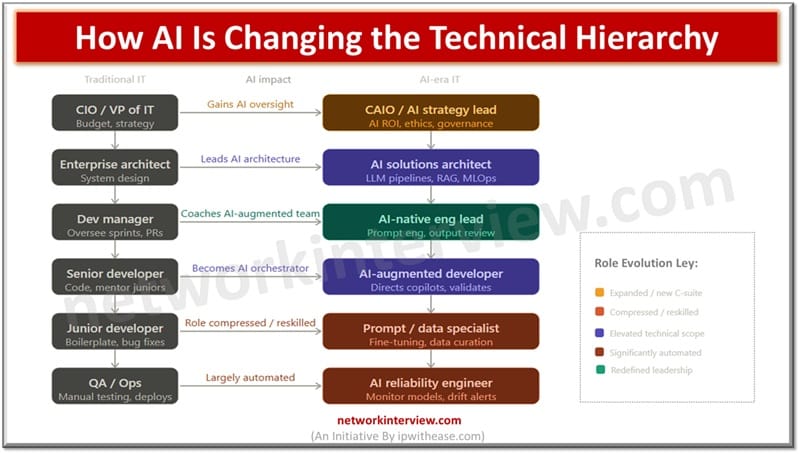
AI Is Changing the Technical Hierarchy in It market like never before. The org chart you learned in 2018 is obsolete. Artificial intelligence is not just automating tasks, it is dismantling job categories, inventing entirely new roles, and rewriting what it means to climb the technology career ladder.
Not since the internet reorganized the back-office in the 1990s has a technology shift hit the internal structure of IT organizations as hard as artificial intelligence is hitting it today. The changes are not evenly distributed — they cascade from the bottom of the hierarchy upward, erasing certain rungs while elevating others into positions of outsized strategic importance.
This piece examines where that pressure is landing, which roles are being created, which are being hollowed out, and what the resulting hierarchy actually looks like for organizations navigating the transition now.
“The question is no longer whether AI will change your IT team — it is whether your IT team will shape how AI is deployed, or simply react to it.”
74% | 3x | 40% |
| of IT leaders say AI has meaningfully changed at least one defined job role in their organization in the past 24 months | faster code production reported by teams using AI copilots — shifting time from writing to reviewing and directing | of routine QA testing tasks now automated at leading tech firms, reducing need for manual test case writers |
The Old Hierarchy and Why It Worked
Classic IT departments ran on a pyramid of expertise. At the top sat the CIO or VP of Technology — the budget holder and strategic decision-maker. Beneath them, enterprise architects designed the big picture: which systems talked to which, how data flowed across the organization, and where technical debt lived. Below the architects were development managers, whose job was to coordinate squads of engineers shipping features within sprint cycles.
That engineering body split neatly into seniors and juniors. Senior developers were the keepers of institutional knowledge — they understood the codebase, mentored newer engineers, and made critical architectural decisions at the feature level. Junior developers did the heavy lifting of production: boilerplate code, CRUD endpoint scaffolding, minor bug fixes, and learning by volume of output. At the base sat QA engineers and operations staff who manually tested builds, wrote regression suites, and managed deployment pipelines by hand.
This structure had a clear logic: expertise flowed downward, execution flowed upward, and the ladder provided a legible career path. A junior developer could reasonably expect to become a senior through years of hands-on coding experience. A senior could earn architectural authority. An architect could eventually run a department. The rungs were predictable, even if the climb was slow.
Where the Pressure Is Landing
AI’s disruption is not uniform. It does not simply “eliminate jobs” in the way that previous waves of automation eliminated factory floor roles. Instead, it selectively compresses certain layers while dramatically expanding the value of others. Understanding which is which is the first step to navigating it well.
The bottom layers are being automated, not eliminated
Junior developer tasks — scaffolding APIs, writing repetitive database queries, generating unit tests for obvious cases — are now handled faster and more reliably by AI coding assistants than by a first-year engineer. This is not a marginal change. Teams using tools like GitHub Copilot or Cursor report producing equivalent feature volume with fewer junior headcount. The entry-level pipeline into software careers is under genuine structural pressure.
QA is similarly compressed. AI can now generate comprehensive test case matrices in seconds, perform regression testing automatically on every commit, and flag anomalies in production behavior without a human writing a single Selenium script. Manual QA testers who specialized in writing test cases without broader engineering skills are the role most directly at risk in the near term.
The middle layer is being redefined, not eliminated
Senior developers are not losing their jobs — they are changing jobs. The new senior developer spends far less time producing code and far more time directing, validating, and interrogating AI-generated code. This requires a different kind of cognitive work: pattern recognition for subtle bugs in AI output, judgment about when to trust a suggestion versus when to override it, and the ability to prompt effectively enough to get production-quality output from a model that does not understand context the way a domain expert does.
The top layer is gaining new adjacencies
CIOs are not being replaced, but they are gaining a new neighbor: the Chief AI Officer. The CAIO role has appeared rapidly in organizations that take AI deployment seriously, covering territory that traditional IT leadership was never structured to handle — model governance, AI ethics policy, vendor evaluation for AI platforms, and ensuring that ROI calculations on AI investments are realistic and measurable.
How AI Is Changing the Technical Hierarchy: The New Role Landscape
Several entirely new job categories have emerged that did not meaningfully exist five years ago. Organizations hiring for these roles are discovering that the talent market is thin — partly because universities have not yet caught up with curricula, and partly because the roles require experience that can only be accumulated by working with the tools themselves.
| Executive | Architecture |
| Chief AI Officer (CAIO) Owns AI strategy, governance, ethics, and return-on-investment for all AI initiatives. Reports to the CEO or board, often alongside the CIO rather than beneath them. | AI Solutions Architect Designs LLM pipelines, RAG systems, fine-tuning workflows, and MLOps infrastructure. Bridges the gap between ML research and production engineering. |
| Engineering | Development |
| AI-Native Engineering Lead Leads teams where AI copilots are first-class team members. Specializes in prompt engineering at scale, output review pipelines, and AI code quality standards. | AI-Augmented Developer Directs AI coding tools to produce features, validates output for correctness and security, and maintains the human judgment layer in AI-assisted development. |
| Specialist | Operations |
| Prompt & Data Engineer Curates training and evaluation datasets, designs prompts for production systems, and manages fine-tuning pipelines that keep models aligned with organizational needs. | AI Reliability Engineer Monitors deployed models for performance degradation, data drift, and behavioral anomalies. Defines SLAs for AI systems and builds observability tooling. |
Before and After: Role Evolution at a Glance
| Dimension | Traditional IT (pre-AI) | AI-Era IT |
| Entry-level work | Boilerplate code, bug fixes, CRUD scaffolding | AI output validation, prompt refinement, edge case investigation |
| Senior developer focus | Writing and reviewing code, mentoring juniors | Orchestrating AI tools, judgment on AI output, domain-level review |
| QA engineering | Manual test case writing, regression suite maintenance | AI behavior testing, adversarial probing, model edge cases |
| Architecture | System integration, database design, network topology | LLM pipelines, RAG systems, MLOps, AI vendor evaluation |
| C-suite presence | CIO with IT budget authority | CIO + CAIO, separate AI governance and technology infrastructure tracks |
| Primary productivity constraint | Number of engineers writing code | Quality of human judgment applied to AI-generated output |
| Skills ladder | Junior → Senior → Architect → Manager | Non-linear; domain expertise + AI fluency outperforms tenure |
Closing Thoughts: The Skills Ladder is Becoming Non-linear
In the traditional hierarchy, a junior developer with three years of experience was expected to progress toward senior, then staff, then principal — each step validated by volume of shipped code. AI disrupts this logic. A developer who deeply understands a domain, can direct AI tools with precision, and has strong judgment about model reliability can operate at a “senior” level of output quality far earlier than the traditional path allowed. Equally, a senior developer who does not develop AI fluency may find their output advantage over a junior disappearing faster than expected.

You may also like
Why Node.js is Perfect for Real-Time Application Development